Merge 2048: predict a row before choosing a direction
A direction moves the entire board, not just the pair you want to join. Before pressing an arrow, read each affected row or column in that direction. Empty squares disappear from the line, equal neighbors combine, and the resulting tiles pack against the edge. The useful habit is to predict that result before a random new tile arrives.
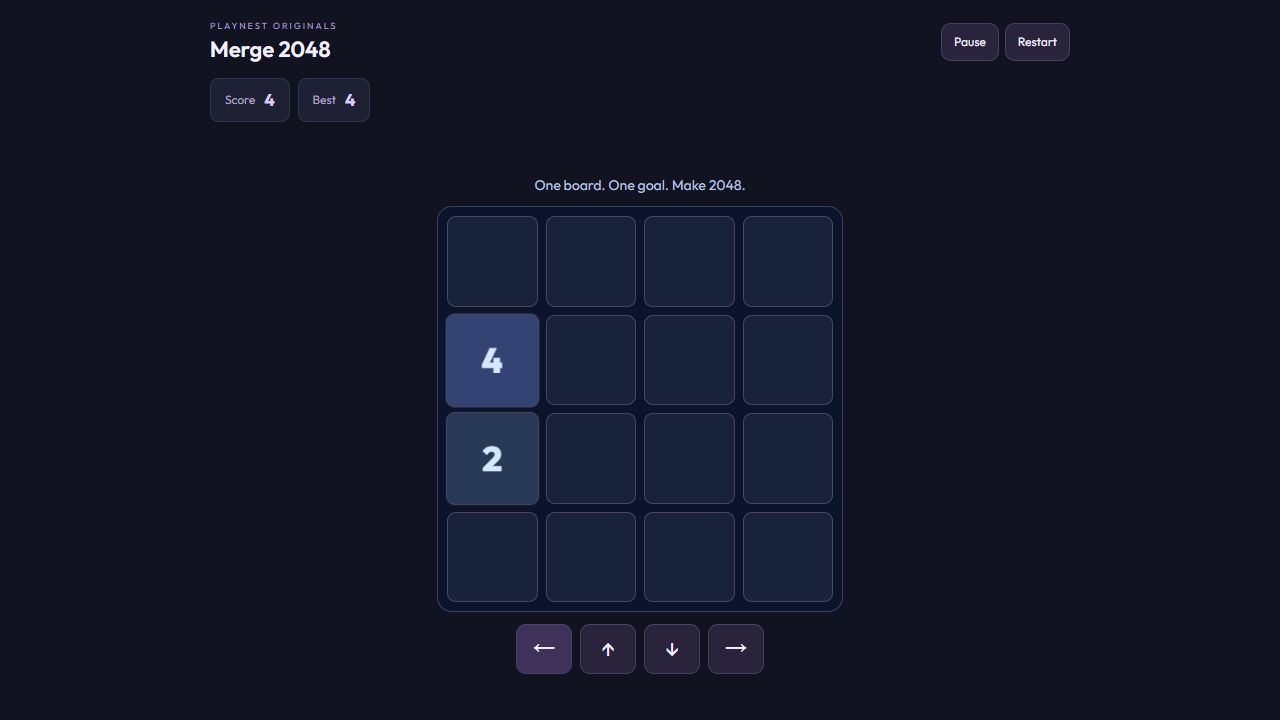
Work through three left moves
These examples describe one row before the new random tile appears. A dot means an empty square. The first pair is resolved from the left, and a tile created by that merge cannot combine again in the same move. That is why four 2s become two 4s rather than a single 8.
| Before moving left | After merging | Score added |
|---|---|---|
| 2 · 2 · | 4 · · · | 4 |
| 2 2 2 2 | 4 4 · · | 8 |
| 2 2 4 · | 4 4 · · | 4 |
| 4 4 8 8 | 8 16 · · | 24 |
Separate the move from the spawn
After an effective move, one empty square receives a new tile: 2 with a 90% probability, otherwise 4. The screenshot shows our first merge and its new tile, but a new game can place its starting pieces elsewhere. A direction that changes nothing neither adds a tile nor adds points. Scoring comes from the values created by merges, not from sliding distance or from the new tile. Two 4s making an 8 add eight points.
Give the largest tile a stable home
Keeping the largest tile near a corner can reduce the number of places you need to organize. If you choose the lower-left corner, build matching values toward it and inspect what an upward or rightward move would displace. The corner is a planning aid, not a guaranteed solution. A move that preserves the largest tile but clogs every remaining square may be worse than a careful rearrangement that creates two useful merges.
Look one move beyond the points
Suppose a left move produces two neighboring 4s. On a later left move those can become an 8, provided the rest of the board still permits that arrangement. This setup is often more useful than a larger immediate score that separates equal high tiles. Count empty squares as working space: a large tile surrounded by unmatched neighbors cannot be rescued simply by pressing its direction repeatedly. Pause and compare the horizontal and vertical possibilities before using the last gap.
A full board can still have a move
Full does not automatically mean lost. Equal neighbors touching horizontally or vertically can still merge; diagonally touching tiles cannot. The round ends when no legal move remains, or when you create 2048. This edition ends at that goal rather than offering an endless continuation. Arrow keys, WASD, swipes and the four direction buttons all use the same rules. Your best score stays in this browser, but Restart or a reload begins a new board; there is no saved unfinished grid or Undo control.
About this guide
Rules checked against this edition’s game code and interface. The screenshot shows the actual game. Strategies are suggestions; they do not guarantee a particular score.